Interactive analytics platform
built for global scale

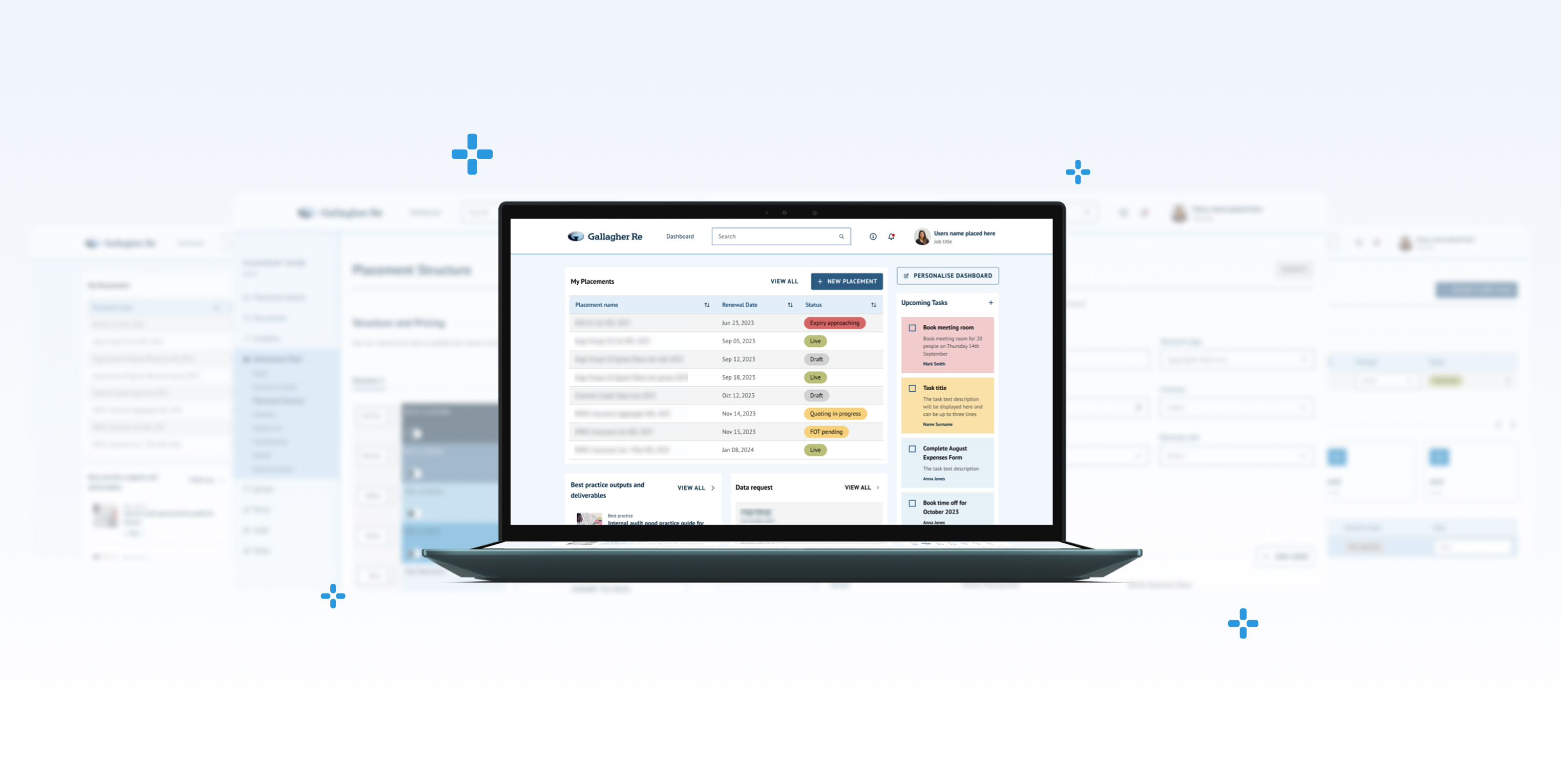
Arthur J. Gallagher's placement operations were fragmented across tools, teams, and continents. We designed a high-impact, web-based analytics platform that unified the full broking workflow — cutting task completion time by 50% and raising user satisfaction by 35% across 2.6k+ employees in 6 continents.
🔒NDA Notice

This project is covered by an NDA. Visuals have been intentionally genericised to protect confidentiality. The focus of this case study is the design thinking, decisions, and process behind the work — not the final deliverables.

About the Company

Arthur J. Gallagher & Co. is one of the world's largest insurance brokerage and risk management firms — serving clients across property and casualty insurance, employee benefits, and risk consulting. Founded in 1927 and headquartered in Rolling Meadows, Illinois, Gallagher has built its reputation on deep market expertise, client-first service, and long-term relationship building.

Despite that scale and reputation, the internal tooling supporting the broking placement lifecycle had not kept pace. Brokers, analytics teams, and carrier management were operating across fragmented systems — with no single environment for conducting placement activities, tracking analytics, or managing the submission-to-policy workflow.

Context

The platform vision

The target state was a single, web-based platform serving as the central access point for all primary users — Brokers, Analytics teams, and Carrier Management — supporting the full placement journey from analytics and submission through to quote generation and policy management.

My involvement

I worked on UX research and UI design across the full discovery-to-delivery arc — from the initial design sprint and vendor evaluation through to information architecture, design system, and high-fidelity interface design in Figma.

Discovery & Strategy

Thirty vendors evaluated.

Before a single screen was designed, the project required a rigorous discovery phase — combining user research, cross-functional alignment, and a structured vendor evaluation to determine the right technical foundation. This phase directly shaped every subsequent design decision.

Design Sprint & Opportunity Mapping

We facilitated a cross-functional design sprint with stakeholders from Broking, Analytics, Carrier Management, and Technology — mapping pain points across the placement lifecycle, defining end-to-end user journeys, establishing required functionality, and aligning on a target-state platform architecture. This phase ensured both user needs and technical constraints were baked into the product vision from day one.
Outcome: A shared, prioritised problem statement and platform vision that aligned all workstreams before any design or technical work began.

Vendor Landscape Exploration (RFI)

An RFI process was launched to evaluate how approximately 30 vendors could support delivery of the target experience. Each vendor was assessed across platform capability, integration potential, scalability, and commercial feasibility. Following initial screening, six candidates were shortlisted for deeper evaluation.
Scale: 30 vendors assessed → 6 shortlisted → 2 vendor types evaluated in depth across structured capability workshops.

Collaborative Vendor Workshops

Shortlisted vendors participated in structured workshops designed to test both solution viability and partnership fit. Two vendor types were assessed in parallel.
End-to-End / SaaS Vendors: Evaluated on UX quality, feature completeness, technical compatibility, and commercial proposals — assessing whether any single platform could meet all requirements out of the box.
Hybrid / Modular Vendors: Assessed on their ability to integrate complementary technologies — exploring whether a modular approach could combine best-in-class components into a coherent platform.

Technical Feasibility & Build Recommendation

A deeper technical review concluded that no end-to-end vendor solution met all requirements, and that low-code approaches lacked the flexibility needed for complex placement workflows. Based on the full research, workshop, and feasibility analysis, I contributed to the strategic recommendation: a custom pro-code platform build — providing full control over UX and workflows, better integration with internal systems, long-term scalability, and a lower lifetime cost than vendor platforms.
Strategic recommendation: Pro-code custom build — the only path that gave full UX control, deep integration capability, and a scalable architecture for a 2,600+ user global platform.

Design Approach

Four principles that shaped the platform design

With the strategic direction set, the design work centred on translating a complex, multi-user workflow into an interface that felt clear, fast, and trustworthy for every user group — from first-time users to power brokers managing high-value placements

Unified Nav & Architecture Model

Designed a single navigation architecture serving Brokers, Analytics teams, and Carrier Management — with role-appropriate views that reduced cognitive load without fragmenting the underlying system. Every user could reach their primary workflow within two interactions.

Scalable Component System

Built a comprehensive Figma component library designed to scale alongside the platform — enabling consistent implementation across complex data tables, form flows, and status dashboards, while giving the development team a reusable, documented foundation.

End-to-End Placement Journey

Mapped and designed the full placement lifecycle within a single environment — from analytics and submission through to quote generation and policy management. Each stage connected directly to the next, eliminating the handoff gaps that had previously cost teams significant time.

Analytics Embedded in Workflow

Rather than separating analytics into a reporting silo, data insights were embedded directly into the placement workflow — surfacing the right information at the right decision point, reducing the need to context-switch between tools.

confidential

The Final Platform screens

Due to a confidentiality agreement with Arthur J. Gallagher & Co., detailed visual deliverables cannot be shared publicly. Screen visuals shown below are intentionally obscured.

Reflection

Gallagher was the project that most clearly demonstrated to me that senior design work is fundamentally about shaping strategy, not just executing it.

Designing for users across 6 continents also underscored how much global scale changes the design problem. Role diversity, workflow variation, and the need for consistency across geographies demanded an architecture-first approach — one where the component system and navigation model had to be solved rigorously before any screen-level work could be trusted to hold up.